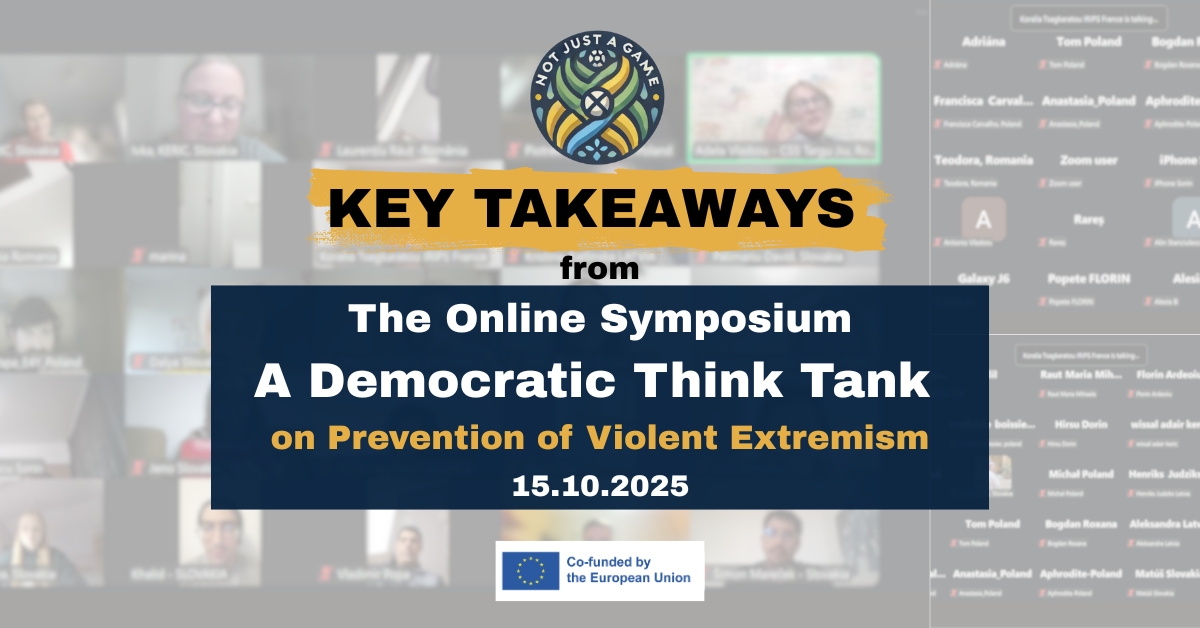
The online symposium for the Not Just A Game project, supported by Erasmus+, successfully concluded yesterday, bringing together youth workers, coaches, stakeholders, and policymakers from across Europe to share progress and discuss how sport can be leveraged to promote social inclusion and reduce the risk of violent radicalization. The event saw 109 participants, with a peak attendance of 70 people actively engaging in the sessions.
The symposium served as a safe and open space for partners to connect and summarize the impactful tools developed so far.
Video Overview: Connecting Partners and Setting the Stage
Audio Overview: Deep Dive into Training, Tools, and Policy Feedback
The audio recording contains detailed presentations on the core outputs of the project and crucial feedback gathered from the participants during breakout sessions:
1. Launch of New Digital Tools
Partners announced the creation and launch of two major open-source tools aimed at practitioners:
- Community of Practice Platform: This online hub is designed as a collaborative space where youth workers, coaches, non-governmental organizations (NGOs), and policymakers can register, network, exchange experiences, and access practical tools. It features blog and forum sections to encourage public discussion and resource sharing on countering violent extremism and promoting positive values in youth.
- Free Online Training Program: A 24-hour, open-source training course composed of six comprehensive modules was detailed. This curriculum is designed for a 360-degree approach, addressing trainers, youth trainers, sports coaches, high school teachers, and young people interested in spotting the signs of radicalization.
2. The Six Training Modules
The partners outlined the key learning objectives for each of the six modules:
- Radicalization and Edu-LARP: This module uses educational live-action role-playing games (serious games) based on Mugadam's staircase model and the 3N model (needs, narratives, networks) to help participants safely spot how radicalization unfolds among everyday people. Feedback emphasized the importance of this experiential learning approach over pure theory, especially for young people.
- Digital Literacy and Online Extremism: Focuses on detecting how gaming, humor, and memes are used to spread extremist ideas and how to use sport and dialogue to build real resilience and critical thinking against manipulation.
- Inclusive and Intercultural Environments: Highlights sport as a language of inclusion, promoting equality, developing intercultural understanding, and building empathy among young people. Participants stressed that inclusion revolves around concepts like care, acceptance, support, and meaningfulness.
- Conflict Management and Communication: This practical module focuses on effective communication, understanding conflict dynamics, and teaching non-violent communication principles and de-escalation strategies. The core message is that clear, respectful communication prevents conflict escalation.
- Ethical Coaching and Mentorship: This section empowers coaches and youth workers to become ethical leaders and role models who prioritize building environments of fairness, trust, and resilience in grassroots sport. Ethical coaching ensures sport remains a safe and supportive space where young people feel protected from negative influences.
- Multi-disciplinary Inter-agency Collaboration: This module stresses that combating radicalization requires cooperation across different disciplines (coaches, teachers, psychologists) and agencies (state, social services, and local authorities).
3. Crucial Practitioner Feedback
During interactive breakout sessions, participants provided crucial feedback that will inform the project’s policy recommendations:
- Cooperation over Competition: A key insight was the necessity to decrease competition and increase cooperation among young people, as this is vital for resolving negative feelings that can lead to radicalization.
- Addressing Risk Factors: Isolation and loneliness were identified as risk escalators. Any team activity with a shared goal helps young people feel part of the community and counter negative influences.
- Policy Relevance: Participants strongly recommended that policymakers must seek feedback from practitioners who are "on the field" working with youth in real-life situations, rather than relying on imaginary scenarios. There was also a call for the state to prioritize resources, such as free or subsidized sports programs, for vulnerable children.
Conclusion and Call to Action
The symposium successfully showcased the practical steps the Not Just A Game project is taking to empower professionals working with youth.
We encourage all interested parties to register on the Community of Practice platform https://notjustagameproject.eu/ to access the training materials, network with peers, and contribute to the ongoing discussion.
Thank you once again to the 109 people who attended and actively contributed to this essential discussion yesterday.
🇪🇺 The Not Just Game project is co-financed by the European Union. The views and opinions expressed belong to the author(s) and do not necessarily reflect those of the European Union or Agence du Service Civique / Agence Erasmus + France Jeunesse & Sport.